
Investing in U.S. commercial real estate allows private individuals to participate in major institutional transactions, building predictable passive income from real property. In this guide, you will learn the fundamental mechanics of the U.S. commercial real estate market, core passive co-ownership structures, risk management practices, and a step-by-step roadmap for international investors entering these deals.
Introduction. The U.S. Market Ecosystem: CRE as a Financial Engine
U.S. commercial real estate functions as a finely tuned financial engine, converting physical square footage into predictable, cash-flowing assets. The resilience of this mechanism rests on three reinforcing pillars: strict legal protection of property rights, sustained demand from corporate tenants, and highly standardized operating procedures.
An institutional approach to capital deployment relies on a clear separation of functions. The investor acts as the capital provider, while a professional operator (the General Partner or Sponsor) handles sourcing, due diligence, debt financing, and day-to-day asset management.
Passive Investor (Capital Provider / LP)
↓
Professional Sponsor (Sourcing, Due Diligence, Management / GP)
↓
Institutional Asset (Multifamily, Logistics, Retail)
↓
Predictable Cash Flow (Passive Real Estate Income)
This architecture enables private investors to own fractional shares in institutional-grade assets—such as multi-million-dollar apartment communities, logistics parks, or shopping centers. Investors enjoy the benefits of owning depreciable real assets while remaining entirely free from property management, tenant disputes, and day-to-day operational burdens.
Fundamental Principles of Cash Flow Generation
At the heart of any successful U.S. real estate investment is predictable cash flow. Cash flow represents net operating income remaining after accounting for gross rental collections, operational expenses, debt service payments, and capital expenditure reserves.
The stability and quality of this cash flow depend on three core structural drivers:
-
Triple Net Leases (NNN Leases): Under a Triple Net Lease structure, the tenant covers all operational expenses of the property—including real estate taxes, building insurance, and structural maintenance. The property owner collects net rental income, shielded from unexpected spikes in operating or utility costs.
-
Credit Tenants: In institutional CRE, primary leases are backed by investment-grade corporations, national retail chains, and logistics giants with strong credit ratings. Their financial strength guarantees long-term lease performance over 10 to 15-year horizons.
-
Built-in Rent Escalations: Lease agreements feature mandatory annual rent increases, structured either as a fixed percentage (typically 2% to 4% per year) or tied to the Consumer Price Index (CPI). This provides a structural hedge against inflation.
Models for Passive Commercial Real Estate Participation
Acquiring major commercial assets individually requires massive equity commitments and deep localized expertise. To maximize efficiency, passive U.S. real estate investments are structured through collective vehicles, providing each investor with proportional ownership in a real asset.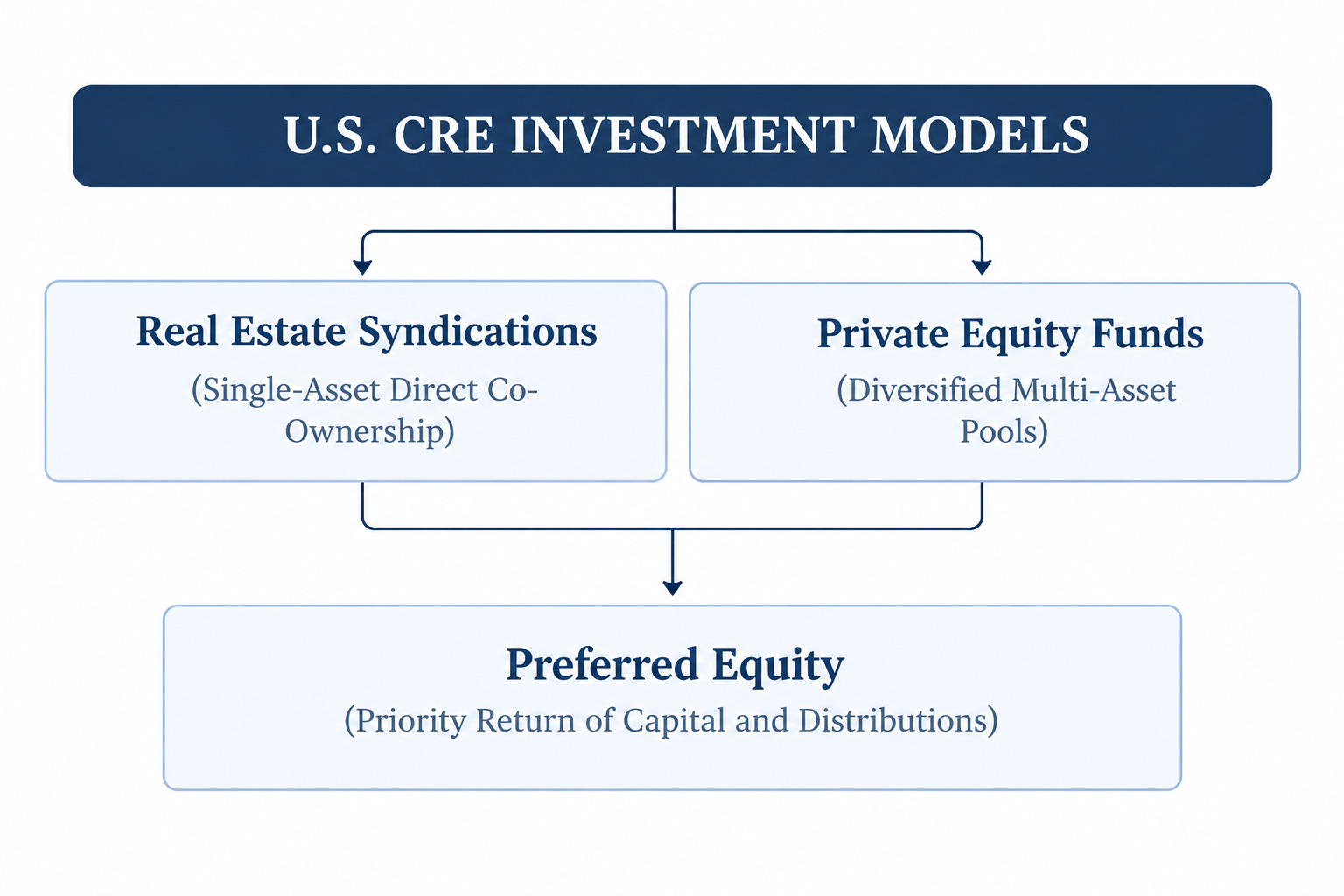
1. Real Estate Syndications
A syndication pools capital from private accredited investors to purchase a specific commercial property. Investors participate as Limited Partners (LPs) in a dedicated Special Purpose Vehicle (SPV), such as an LLC or LP.
Limited Partners receive limited liability protection up to their capital contribution, alongside priority rights to ongoing rental distributions and capital gains upon asset sale. The deal Sponsor (General Partner, GP) executes the business plan and assumes loan guarantees.
2. Private Equity Real Estate Funds
Private Equity funds pool investor capital into a single vehicle designed to acquire a diversified portfolio of commercial assets. Investing in a PE fund delivers immediate diversification across geographies, asset classes, and tenant bases.
The fund manager executes strategic decisions—including capital deployment, portfolio optimization, and asset dispositions—while distributing quarterly dividends to fund investors.
3. Mezzanine Debt and Preferred Equity Pools
Mezzanine debt and Preferred Equity sit between senior bank debt and common equity in the capital stack. Investors provide capital to developers or sponsors, secured by equity pledges in the project.
Preferred Equity investors receive prioritized, fixed returns (typically 8% to 12% annually) and hold payment priority over common equity holders. This structure delivers income consistency with downside capital protection.
Core Asset Classes for Consistent Income
Different commercial sectors respond uniquely to economic cycles. Building a resilient portfolio requires matching capital allocations with asset classes that match your income and growth profile.
1. Multifamily Residential Communities
The multifamily sector encompasses institutional apartment complexes (100 to 500+ units) under single ownership. Housing fulfills a fundamental human need, keeping occupancy rates consistently high across economic cycles.
Population growth, urban migration, and housing affordability pressures drive sustained renter demand. Short lease terms (typically 12 months) allow operators to regularly adjust rental rates to current market levels.
2. Industrial and Logistics Facilities
Industrial and warehouse assets show sustained growth, driven by e-commerce expansion and supply chain restructuring. This asset class includes last-mile distribution centers, regional fulfillment hubs, and light industrial parks.
Industrial assets feature low ongoing maintenance expenditures, long lease terms (5 to 15 years), and creditworthy corporate tenants.
3. Grocery-Anchored Neighborhood Retail
Neighborhood retail centers built around major grocery chains, pharmacies, and essential service providers show strong resilience against shifting consumer habits.
Anchor tenants generate daily foot and vehicle traffic, driving sales volume for inline service tenants (restaurants, medical clinics, personal care). This dynamic supports steady occupancy and rental collection resilience.
Risk Management and Profit Distribution Frameworks
Professional real estate ownership requires rigorous risk mitigation controls. Experienced Sponsors apply institutional mechanisms to protect capital while driving risk-adjusted returns.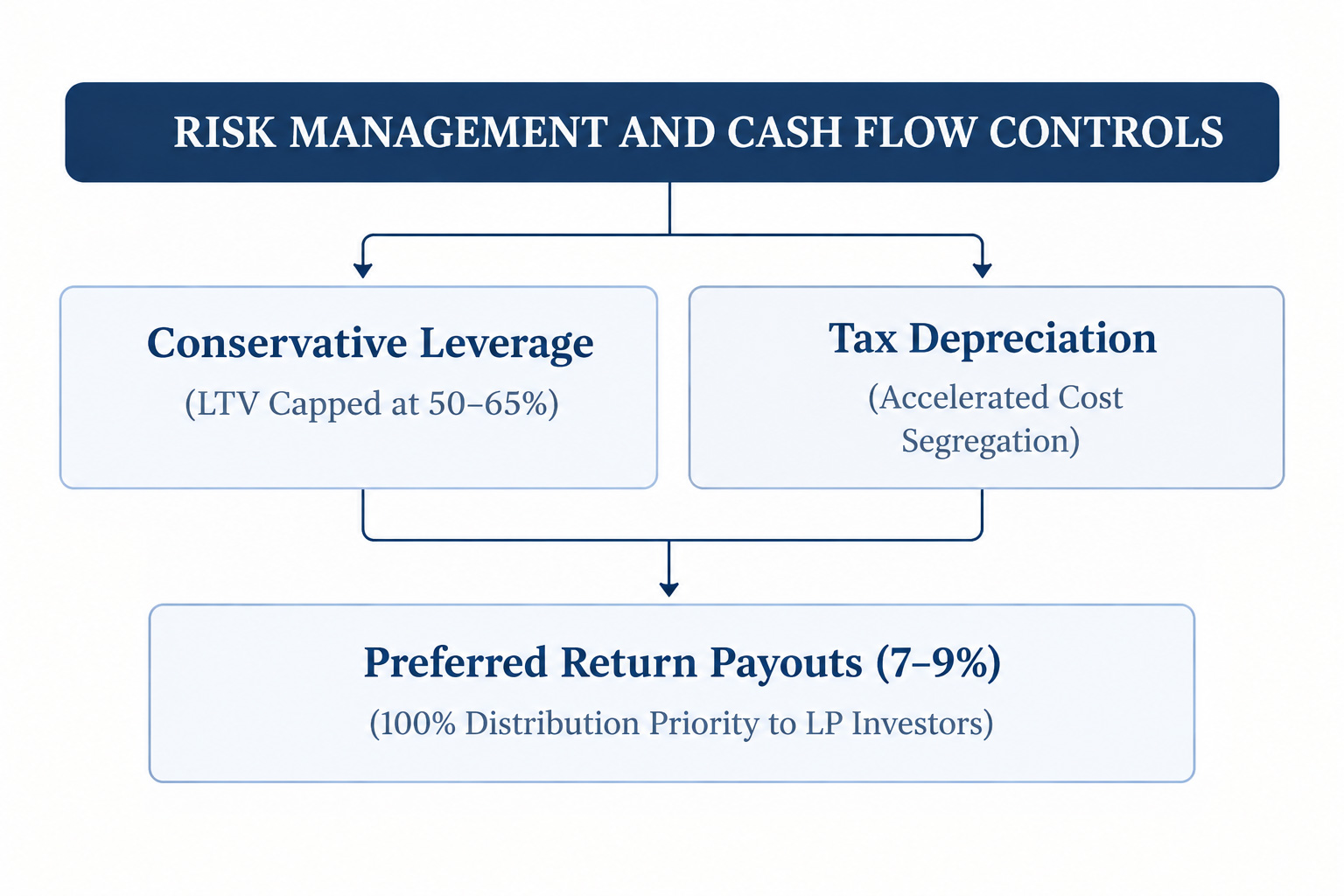
Core capital protection mechanisms include:
-
Conservative Financial Leverage (LTV): Maintaining conservative Loan-to-Value ratios (50% to 65%) shields assets from interest rate volatility and refinancing risks.
-
Tax Optimization via Depreciation: U.S. tax policy permits real estate owners to offset taxable income using non-cash depreciation expense (further optimized via Cost Segregation studies). This allows investors to collect cash distributions with low or zero current tax liability.
-
Preferred Return Structures: Institutional deal terms mandate a Preferred Return hurdle (typically 7% to 9% annually), meaning Limited Partners receive 100% of cash flow distributions until their baseline return target is met before the Sponsor earns performance fees (Promote).
Step-by-Step Investor Roadmap
Participating in U.S. commercial real estate requires a disciplined investment process. Following a systematic approach ensures thorough due diligence from initial evaluation through capital deployment.
Step 1. Define Investment Profile and Criteria
Establish clear parameters: total equity allocation, target yield metrics, investment horizon (typically 3 to 7 years), and asset class preferences.
Step 2. Sponsor Vetting and Due Diligence
Audit the Sponsor's operating track record. Review historical performance, realized Internal Rates of Return (IRR), distribution history during market downturns, and Sponsor co-investment skin-in-the-game.
Step 3. Investment Memorandum Review (PPM Analysis)
Examine the deal financial model, operating expense projections, rent growth assumptions, exit cap rate scenarios, and legal documents—including the Private Placement Memorandum (PPM) and Operating Agreement.
Step 4. Legal Structuring and Subscription Execution
Form suitable legal entities (such as offshore LLCs or holding structures) to hold investment shares. Execute the Subscription Agreement and Operating Agreement.
Step 5. Capital Wire and Deal Activation
Wire investment funds to an escrow or project account. Once closed, the investor is recorded on the company register and becomes eligible for regular distributions.
Step 6. Ongoing Passive Income and Financial Reporting
Receive quarterly asset management reports detailing property operations, financial performance metrics, and direct bank wire dividend distributions.
Conclusion
Investing in U.S. commercial real estate provides a proven mechanism for capital preservation and wealth accumulation through direct participation in real assets. The U.S. commercial market offers a transparent environment for international investors seeking passive income without operational headaches.
Partnering with experienced Sponsors, leveraging syndicated institutional models, and allocating capital to high-quality asset classes provides strong downside protection. A systematic investment strategy allows you to build a resilient portfolio of cash-flowing real estate assets, generating reliable income and capital appreciation for decades to come.
This material is for general information only and does not constitute legal, immigration, investment, or tax advice. Program requirements and processing practices may change. Individual results depend on the applicant’s circumstances, visa availability, USCIS decisions, and project performance.